Endangered parrot habitat in urban areas
Innovations in species distribution modeling
4/23/20262 min read
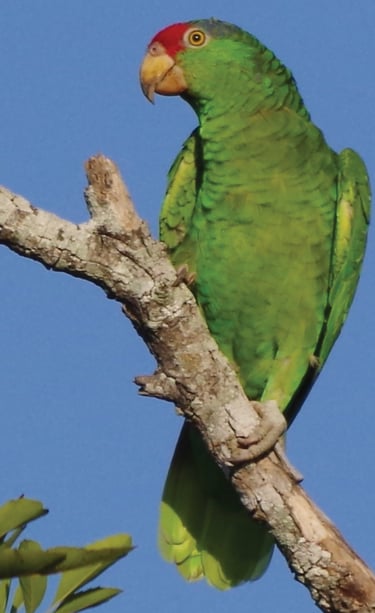
I am excited to get to share some work by a former student. EV Voltura took a class with me many years ago, and now she's Dr. Voltura, a researcher at Texas A&M University. She was enthusiastic about studying birds back in my course, and she's still living out that fascination. Her 2023 PLOS One paper is that dedication made manifest. It's also a great example of how to use ecological modeling for wildlife conservation.
She and her colleagues were trying to model the distribution of an endangered parrot - the red-crowned parrot (Amazona viridigenalis) - in southern Texas. Although populations of this parrot in southern Texas are small, they're living in a surprising place. They prefer vegetation in urban areas. In that way, they seem to be a little like Eastern gray squirrels or raccoons, thriving in proximity to human developments.
For this modeling, the authors used a correlation approach, looking for variables that tied closely to the parrots' distribution. These birds likely rely on mature vegetation for habitat. Large trees likely provide hollows for nesting, for example. Working from aerial imagery, they developed vegetation indices. I encourage you to read their paper to understand some of the basics of vegetation indices, and how and why they developed the ones they used for their research. To keep it simple, they used vegetation indices that are effective in urban landscapes. They also looked at how the vegetation index changed over time. This is important because it's an indication of whether the vegetation is seasonally stable habitat for the parrots.
Once they had established their vegetation index variables, they used statistics to build models out of the variables and select the variables and models that worked best together to explain the distribution of these birds. I've done similar work developing models in the past, but this is an updated technique. James Tracy and colleagues developed this approach for modeling wildland fire in the Western US in 2018, which they called "random subset feature selection algorithm" or RSFSA. Using RSFSA, the authors were able to find suites of variables that were highly effective (~94% of the variance explained). These models used vegetation as well as physiographic features like elevation to explain the distribution of parrot nesting sites, roosting sites, and areas of general use.
This is an elegant piece of modeling work. It has important implications for the conservation of this endangered parrot. Urban populations of red-crowned parrot may prove essential for conserving this species. And their approach should be useful for other conservation applications as well.